Wednesday, May 30, 2007

On Writing Mysteries and Raising Boys

by Julia Buckley
I wrote this essay a year ago, but because I find that it's still equally true today, I thought I'd share it for those of you who might have similar life conflicts.

Writing mysteries and raising boys: these two things don’t always go together—at least not as smoothly as I’d wish. For one thing, boys will ask for all the attention you have, and then lots of attention beyond that. They want to wrestle dangerously near the coffee table, pick up the cat under his stomach right after he drinks milk, and see what happens when you blow in the dog’s face. (The answer to the last one is—he goes insane and bites your baby lip, whereupon you cry and leave gouts of blood all over the house like you’re auditioning for Macbeth). They want to tattle on each other and jump on the neighbor’s trampoline (blast the neighbor) and argue over one Lego even while they sit in a veritable sea of them, wave upon wave of unwanted Legos that are good only for adults to step on in the dark.

Naturally this does not allow one to sit at the computer for a long, leisurely time, at least not without yelling “Cut it OUT!” at regular intervals, and this rather breaks the concentration. So one must write when one can. And when one is me, that means I write in fits and starts. Not only am I sometimes called away by my boys; there is my mother guilt to contend with. It’s always been there, of course, ever since that first day when I allowed the doctor to circumcise my baby at the hospital and then felt miserable for weeks afterward at what I’d let those evil doctors do. By the time my first infant rolled off the bed while I was hunting for a pair of socks, my guilt was firmly and permanently in place. I called the hospital, weeping harder than the baby, and the doctor asked me in a bored tone if the baby was, perchance, vomiting. No, said I, and he said, “Babies have hard heads.”

Due to guilt, one cannot write all day long, especially not when cute children ask, “Can you read this to me?” You can’t ignore that, not unless you want Harry Chapin singing in the back of your mind all day about cats and cradles and silver spoons. Sometimes you can’t write at all. I’m about to embark on a lovely leisurely summer, but soon enough I’ll go back to work and night school, which I call Panic Attack Season.

Ironically, though, when one is inundated with non-writer responsibilities, one can develop writer guilt. Similar to mother guilt, it niggles at the back of one’s mind (also, ironically, to the tune of a Harry Chapin song) and asks why there is no new project in the offing and why the old project hasn’t been polished smooth.

So when I lie next to the boys at night and sing them a few lullabies—yes, I do it, but not in as Julie Andrews a way as I’d like—I find that my writer guilt is there, saying ‘Get downstairs and type something.’ But there’s always a boy with insomnia, always, and he’s not that thrilled with the idea of my departure. So I become half sweet lullaby mother, half grumpy military mother who wants to leave. It sounds like this:

ME: (soft and lilting) Oh Danny Boy, the pipes, the pipes are calling—

BOY: How can pipes call?

ME: (not lilting) No talking. From glen to glen, and down the
mountainside . . . PUT YOUR ARMS DOWN! The summer’s gone . . . and all the roses falling . . . ‘tis you, ‘tis you—GET YOUR FEET OFF THE WALL!

BOY: Who farted?

ME: (Not even distantly related to lilting) That’s IT. I’m getting your
father.

And the challenge continues. Not surprisingly, there are children in every book I’ve written so far. I’ve been told I write children very realistically. I guess it’s from being in the mother trenches. Does this help at all with writing mysteries? Well, writers who are parents deal with a daily mystery—how are they ever going to get anythi--

Gotta go!

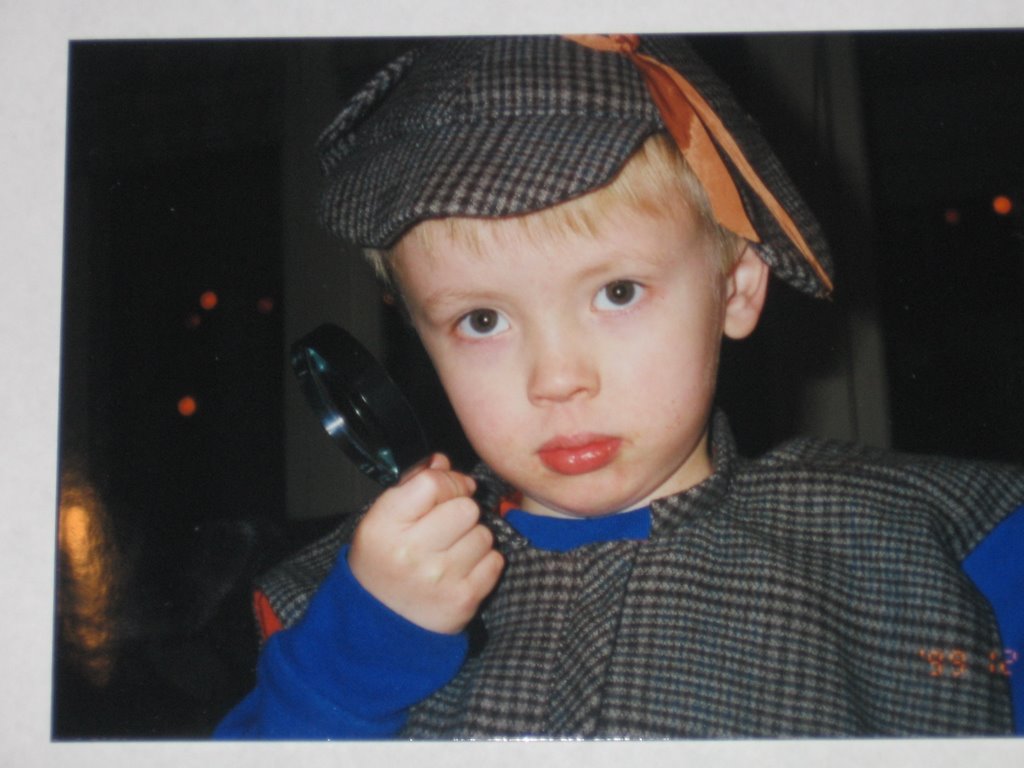
(Image: my eldest son at age 5 (he's 12 now) in a Sherlock Holmes outfit made by my mom.)

Tuesday, May 29, 2007

Start At The End

By Joe Moore

Kurt Vonnegut once revealed his 8 rules of writing fiction. They’re worth reviewing and taking to heart. But his rule number 5 is the one that made the biggest impression on me. Rule number 5 is: Start as close to the end as possible. This is relevant for both the entire book or a single chapter. We often hear that the most common mistake of a new writer is starting the story in the wrong place.

Well, it happens to published writers, too. Lynn Sholes and I are writing our fourth book together and we still make that mistake once in a while. We’ve written whole chapters that either occurred in the wrong place, or worse, weren’t even needed. Usually they turn out to be backstory information for us, not the reader. We go to the trouble of writing it only to find it’s to confirm what we know, not what the reader needs to know.

So if we apply Vonnegut’s rule number 5, how do we know if we’ve started close enough to the end? Easy: we must know the ending first. To me, this is critical. How can we get there if we don't know where we're going? And once we know how our story will end, we can then apply my top of the mountain technique. In my former career in the television industry, its called backtiming—starting at the place where something ends and working your way to the place where you want it to begin.

But before I explain top of the mountain, let’s look at the bottom of the mountain approach. You stand at the foot of an imposing mountain (the task of writing your next 100K-word novel), look up at the huge mass of what you are going to be faced with over the next 12 months or so, and wonder what it will take to get to the top (or end). You start climbing, get tired, fall back, take a side trip, climb some more, hope inspiration strikes, get distracted, curse, fight fatigue, take the wrong route, fall again—and if you’re lucky, finally make it to the top. This method will work, but it’s a tough, painful way to go.

Now, let’s discuss the top of the mountain technique. Imagine that you’re standing on the mountain peak looking out over a grand, breathtaking view feeling invigorated, strong, and fulfilled. Imagine that the journey is over, your book is done. Look down the side of the mountain at the massive task you have just accomplished and ask yourself what series of events took place to get you to the top? Start with the last event, then the second to the last, then . . . you get the idea. This takes it a step further than Vonnegut’s rule number 5 by starting at the end and working your way to the beginning. Guess what happens? By the time you are actually at the beginning, you will have started as close to the end as possible. Rule #5 rules!

See you at top of the mountain!

Monday, May 28, 2007

Memorial Day 2007

“I hope that on Memorial Day when people think about our soldiers, they won’t just think about the ones who died—they’ll think about those who came back different,” said the woman caller.

Tom Ashbrook, host of On Point, probed gently, asking if there was anyone specific the woman had in mind.

“My husband. He came back from Iraq, and…he’s different. Because of what he saw…and went through,” she struggled with the words.

On Memorial Day, we pause and remember the dead. But that’s not enough. A count of headstones does not include all those who sacrifice for our nation. Some die on the battlefield or in hospitals far from home. But others return marred, scarred, and changed: never the men (or women) they once were. They, too, give their all.

Take Arthur Middleton, for example. In 1776, he was a delegate to the Continental Congress. A Cambridge graduate, he was more radical than his father, Henry, who served as the second President of the Continental Congress, and thus the leader of what was to become the United States from Oct. 22, 1774 to May 10, 1775.

Arthur’s attitude toward Loyalists was said to be ruthless. When he pledged his life, his liberty and his sacred honor, he meant exactly that. In 1781, Charleston, South Carolina, was overrun by General Clinton and the British army. Arthur Middleton was asked to swear a new loyalty oath. In John Jakes’ bestseller Charleston, he writes, “Many important names—Middleton, Pinckney, Manigault, Hayne—obliged.”

Jakes has it wrong. Very, very, badly wrong.

Arthur Middleton refused. So did Pinckney.

Middleton taken prisoner, thrown onto a British warship and taken to a jail in St. Augustine, Florida. There in a small coquina cell, with vaulted ceiling and wet walls, he carved his name—a twin to the bold signature on the Declaration of Independence. He was held more than a year before he was exchanged in a prisoner swap. By then, most of his fortune was gone.

He died at age 44, about four years later. The legend beneath his portrait in the Charleston Museum, suggests he died of an illness contracted while in prison, which possibly would have been malaria.

Arthur Middleton is buried at his family home Middleton Place. To see it go to http://www.middletonplace.org/ Or rent The Patriot (Mel Gibson), and you’ll see footage of the gardens and the house’s interior.

So Middleton did not die on a battlefield, but he gave his life in service to our country. As the caller to On Point suggested, on Memorial Day we need to remember all those who have served, both living and dead.

Today as we put up our flag, I said a prayer thanking all the soldiers and patriots in my family, including my ancestor Arthur Middleton.

Saturday, May 26, 2007

InkSpot News - 26 May 2007


DEB BAKER will be signing Murder Grins and Bears It in Door County, Wisconsin this weekend!
  • Friday, May 25, 12-2pm, Book World, Sturgeon Bay, WI

  • Saturday, May 26, 10-1 Pages, Egg Harbor, WI

  • Saturday, May 26, 2pm, Novel Ideas, Baileys Harbor, WI

  • Sunday, May 27, 1-3pm, Book World, Sister Bay, WI


MARK COMBES Running Wrecked is out!

It's not the spectacular diving that brings Phil Riley to Isla Tortuga. This sleepy corner of the Caribbean is the perfect refuge for ex-patriots who need a fresh start. With good friends, an ample supply of beer, and a dive shop to run, theres plenty to distract Riley from his troubled past . . . until he discovers the Miss Princessa beautiful sailboat, mysteriously left adrift off the coast of his new island home.

What compels Riley to investigate the Miss Princess? The bewildering lack of concern shown by the police? The disappearance of his friend? Or maybe Riley hopes to ease the haunting memories of a terrible accident that drove him to this island hideaway.

Fueled by sheer will and unreliable instincts, Rileys clumsy attempt at playing detective could possibly foil a kidnapping scheme and save a familyor cost him his life.

Learn more about Mark and the Phil Riley novels at www.markcombes.com!

Friday, May 25, 2007

Simile Contest

Mystery writers love simile. A simile is, of course, a comparison between two unlike objects, using the words "like" or "as..as a," as in, "She was as hungry as a tapeworm in a fashion model." Noir is famous for its use of similes, and Raymond Chandler sets the bar. Here's a few of his greats:

"Dead men are heavier than broken hearts "---The Big Sleep

"The minutes went by on tiptoe, with their fingers to their lips." ---The Lady in the Lake

"I'm an occational drinker, the kind of guy who goes out for a beer and wakes up in Singapore with a full beard." --"The King in Yellow"

Beautiful, no? It makes the language walk right out and smile at you. Then there are, of course, the "worst similes ever," written by high school students. They circulate the Internet every few years, so I'm not sure if they're actually by high school students. I love 'em, though. Here's a few of my favorites:

"The plan was simple, like my brother-in-law Phil. Unlike Phil, however, it just might work."

"Her date was pleasant, but she knew if her life was a movie, this guy would be buried in the credits as something like 'Second Tall Man.'"

Wonderful. Here's my challenge to you. Write a fantastic simile, one that makes me laugh, think, or retch. Post it as a reply to this post. The winner gets a free copy of May Day, the first in my Murder-by-Month mysteries. (If you've already ready May Day, I'll send you a copy of June Bug. If you've already read them both, bless you.)

Thursday, May 24, 2007

Family Game Night


My son’s 4th birthday is coming up in three weeks and my husband suggested buying him a preschool-level game system from Best Buy. At first, this idea sounded great. Why, my son could practice his counting and could identify colors, letters, and shapes while chasing after Dora the Explorer or racing around with Lightning McQueen. Yeah! Let’s get it for him!

But then I stopped to think…

Game systems are solitary. Do I really want my son facing a television screen instead of his family? The answer is no. I’ve waited years to be able to play games with this kid and we’re going to start this summer, danggone it! And by games I mean the type that you set up, play, and put away in a box that’s held together by masking tape because it’s been lovingly used and abused for a long time.

When I was growing up, we had two family games. The first was backgammon. My dad loved the game and taught us all how to play at an early age. We also favored a card game called 7-Up, which we played using pennies for the kitty. Other nights my brothers and I unpacked Sorry, Life, Battleship, Monopoly, or Risk and kept ourselves content for at least an entire hour (other than typical sibling squabbles centering on peeking at the location of the opponent’s PT boat or helping oneself to several twenties whilst being the banker during a Monopoly game).

So I was wondering…Do you have a Family Game Night every now and then? What game(s) do you keep returning to and what food do you eat along with your game?

Wednesday, May 23, 2007

An Apology for Mystery Writers

By G.M. Malliet
My husband and I have a small pond at the back of our patio. It’s a legacy from the man who previously owned our house. The pond is about five feet long, three feet wide, and two feet deep. About the size of a shallow grave, in fact. A small concrete turtle sits on the edge of this pond and picturesquely regurgitates water from a tube in its mouth.

I’ll admit, it’s a charming idea to have this thing around to create a Zen-like tinkling background noise all day long. The gurgling turtle serves as a daily reminder to us of mankind’s mysterious and eternal connection with nature, and so on. Birds and even raccoons often stop by for a quick bath. Cute.

But. The maintenance is nonstop. It’s painful to spend every weekend cleaning out the leaves and assorted gunk that collects in our little pond, and unclogging the turtle’s stopped-up tube for the hundredth time.

The other day the pond’s electric pump gave out, the turtle spat no more, and we stood looking at our bacteria-infested, mosquito-breeding pond water debating if it wouldn’t be better to just fill the thing up with dirt and be done with it. Plant rosebushes or an evergreen there, instead.

Or, better yet, pour concrete inside and top it all off with something useful, like an outdoor fireplace.

The latter option held the most promise. But as we weighed our choices, not to mention our chances of finding a bricklayer who would show up as promised, I said, thinking aloud, really: “Damn. It’s too bad we don’t have a dead body we’re trying to hide.”

It is at moments like these my husband gets a startled, wary look in his eyes, like Joan Fontaine when she realizes Cary Grant has probably just done away with his best friend Binky. You’d think Bob would be used to it by now. Any man who at least once a week finds a cryptic, scrawled note in the kitchen that says something like “Nightshade -- fatal dose? Cowbane better?” should really have learned by now to shrug off these mystery writer moments.

So I hastily added, “Just kidding, dear. You’re too large to fit in there. But what if…”

I wandered away, a glazed look in my eyes that he now recognizes as a sign I’m off to kill someone on paper.

This kind of thing probably does keep spouses on their toes.

But Bob has nothing to worry about.

Really.

Tuesday, May 22, 2007

Backyard Revisited


By Deb Baker

I grew up in the Michigan U.P. where my Yooper mystery series takes place. When I was looking for material for my first book, I thought my childhood was just like everyone else’s. But I gave it some thought and decided it had been a little unusual.

We had bugs the size of Volkswagen Beetles. One year my grandmother’s house was pre-ner plastered with bay flies. Once when we were picking blueberries in our secret place, I spotted a spider the size of a half-dollar (remember those coins) and beat it out of there. We really do vacuum up those black flies that swarm in the windows in early spring. Wood ticks don’t fly but they do leap at you from trees.

Saunas and bars are our social hubs in the same way you’se guys enjoy fitness centers and coffee shops.

We can tell the difference between a squirrel, a chipmunk, and a skunk.
Men don’t remove their baseball hats except for church.
Women hunt and fish and make a point of out-doing the men.

During deer hunting season we have to dress our dogs in orange and even then some Troll (that’s what we call Lower Michigan residents because they live below the Mackinac Bridge) will shoot at them.

Upper Michigan should have been its own state or at the very least should have tagged onto Wisconsin. We root for the Packers and make pilgrimages to Green Bay to honor St. Vincent Lombardi, who coached da Packers.

We drive on Lake Michigan and Lake Superior in the winter and we all know what black ice is. Its ice camouflaged as black top. If you hit it, you can kiss your hinder goodbye.


We eat anything and everything – Trenary toast, Cudighi (a sausage invented in Ishpeming), Pasties (not the things exotic dancers wear). We love sugar doughnuts and coffee, lots and lots of it. Mackinac Island fudge. Roadkill (but only if it’s fresh). Kalja (beer).

Yes, I considered all of this perfectly normal. So the next time you’re looking for something unique to write about, check out your own back yard.

Hot off the press – Murder Grins and Bears It, Next up – Murder Talks Turkey