By Joe Moore
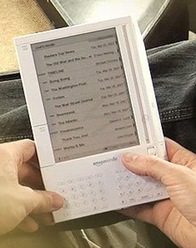 Amazon recently announced the introduction of their new Kindle e-book reader. If you visit the website and watch the promos including the impressive endorsements from James Patterson, Toni Morrison, Anita Diamant, and others, you’ll see that this is a cool device. Yes, there’ve been other e-book readers in the past, but this one has some special features that are unique. Besides the light weight, large storage capacity, and “electronic paper” display, the thing that really got my attention was its wireless capacity to download from anywhere without the use of a PC, cell phone, or any Wi-Fi hotspot connection. Wireless download from just about anywhere is included in the cost of the device. It’s also got a built-in dictionary, wireless access to Wikipedia, and other nifty features.
So is the Kindle the one? Maybe, maybe not. But it’s a sure sign of things to come. Especially if a giant like Amazon gets behind it. The biggest hurtle that the Kindle and similar devices have to overcome is the technology itself. A book is probably the most ingenious storage device ever invented. Why? Because the basic format has not changed in thousands of years. And a thousand years from now, someone can pick up a book printed today and read it. There’s no guarantee that the technology supporting the Kindle will last a decade. What if batteries are suddenly no longer made to power the Kindle? What if the format is no longer efficient to archive the written word? What if a new device comes along that holds a thousand times more data at a fraction of the cost? What if it simply isn’t manufactured anymore and you still have one that needs servicing.
Remember 8-track audio cassette tapes? Betamax? 78 RPM phonograph records? VHS? Heck, it's even getting hard to find a CD anymore now that MP3 has come along. How about CRT video monitors? Anyone you know still have one now that the cost of LCD flat monitors are approaching the price of a McDonalds Happy Meal? If the device that's needed to play the media is not preserved along with the media, you're out of luck. There's no chance of that happening with books because they are their own storage device.
But before we cast judgement on e-book readers like Kindle and say they're a passing fancy that will quickly go the way of the rotary dial phone, let's revisit a few pieces of innovation from the past that didn't catch on at the beginning.
"This 'telephone' has too many shortcomings to be seriously considered as a means of communication. The device is inherently of no value to us."
-- Western Union internal memo, 1876
"I think there is a world market for maybe five computers."
-- Thomas Watson, chairman of IBM, 1943
"640K ought to be enough for anybody."
-- Bill Gates, 1981
"But what... is it good for?"
-- Engineer at the Advanced Computing Systems Division of IBM, 1968, commenting on the microchip
"There is no reason anyone would want a computer in their home."
-- Ken Olson, president, chairman and founder of Digital Equipment Corp., 1977
"The wireless music box has no imaginable commercial value. Who would pay for a message sent to nobody in particular?"
-- David Sarnoff's associates in response to his urgings for investment in the radio in the 1920s
"The concept is interesting and well-formed, but in order to earn better than a 'C,' the idea must be feasible."
-- A Yale University management professor in response to Fred Smith's paper proposing reliable overnight delivery service. (Smith went on to found Federal Express Corp)
"So we went to Atari and said, 'Hey, we've got this amazing thing, even built with some of your parts, and what do you think about funding us? Or we'll give it to you. We just want to do it. Pay our salary, we'll come work for you.' And they said, 'No.' So then we went to Hewlett-Packard, and they said, 'Hey, we don't need you. You haven't got through college yet.'"
-- Apple Computer Inc. founder Steve Jobs on attempts to get Atari and HP interested in his and Steve Wozniak's personal computer
"Everything that can be invented has been invented."
-- Charles H. Duell, Commissioner, U.S. Office of Patents, 1899

 (Photo credit: "Solitude" by David Lorenz Winston)


