Showing posts with label MWA-U. Show all posts

Friday, July 22, 2011

Dangerous: Writing while Reading, by Jess Lourey

What, if anything, do you read while writing? For me, usually nothing. I’m a full-time teacher and a mother of a 12 and a 9 year-old. imageI also have a wonderful boyfriend, serve on the national board of the Mystery Writers of America, am active in Tae Kwon Do, and volunteer in my community. When I add writing a novel on top of that, reading is usually the first thing that has to go. However, the young adult novel I’m working on at the moment requires a great deal of research. I find myself writing in fits and spurts, broken up by necessary reading, and it’s driving me crazy!!! I can’t meet my 2000-word-a-day minimum, and I feel like a humongous slacker.

So maybe this post is more about asking how you all make time for writing. I get asked that question regularly, of course. Every writer does. One time, a couple years ago, I half-jokinglyimage (which=embarrassingly true) told a reporter that I have time to write novels because I don’t watch TV, have a social life, or shower on the weekends. That become the two-page, full-color headline for the article, over a photo of me with my 19-year-old cat in my arms: “I Don’t Have a Social Life and I Don’t Shower on Weekends.” This is how cat ladies are born, people. Shame combined with the realization that personal hygiene is negotiable.

Nowadays, when I teach creative writing for MWA-U and am asked how I make time for my writing, I gently correct my students. We all make time for what is important, I say, so the question is not how to make time for writing but how to make writing important to you.

That answer works great as long as you’re not under deadline, right? I need to get this YA novel done by September 1, the imageDecember book in my Murder-by-Month series by December 1, and I hope to have a magical realism novel completed by May 1, 2012. I had it all within my grasp, right up until I realized I had far more research to do for the YA novel than I had allotted time for. So I repeat: how do you make time for writing, especially when it requires researching?

On a profoundly unrelated note, last month, my publisher kindly put forth June Bug as a free ebook download. Tens of thousands of copies were downloaded, and even more exciting, the sales of the other five books skyrocketed. You know what else? The entire six-book e-series is still in the top 10,000 ranking for Amazon.com’s Kindle downloads, weeks after June Bug has returned to full price. Thank you to Midnight Ink for their brilliant support and inventiveness, and for allowing me this opportunity to reach a new group of readers.

And finally, this is my last post for Inkspot. I’m going to toot my imageown horn and say that starting this group blog was my idea a few years back, and it’s morphed into this amazing thing through the efforts of some of the best writers in the business. Thank you for your time and friendship, Inkspotters, and I’ll continue to follow your stories with great anticipation.

p.s. Breaking news!!! Thanks to an Amazon.com promotion and some more forward-thinking from my publisher, Knee High by the Fourth of July is a $1.99 Kindle download for this week only. Read on!

Friday, June 24, 2011

Creating Vivid Settings in Fiction, by Jess Lourey


This past weekend, I attended the Southeast Wisconsin Festival of Books, a two-day (free!) event featuring authors, cooks, readers, critical thinkers, and general lovers of the arts. Besides learning how to make a great Thai curry, I also heard William Kent Krueger deliver one of the most inspiring and humbling keynote speeches I've ever heard.

I also had the great honor to teach the "After the Idea" class for MWA-U. MWA-U is a low-cost, all-day, college-level, fiction-writing seminar sponsored by the Mystery Writers of America. It consists of six classes, each taught by a different instructor and each building on the course before it. My presentation explained in seven manageable steps how to turn your idea into a full manuscript, Hallie Ephron then brilliantly outlined the secrets of suspenseful plotting within that manuscript, and so on.

John Galligan, a Wisconsin creative writing professor, was a new instructor in the line-up. He taught the "Setting and Description" class, and it's his method for crafting vivid details that I'd like to share with you now. According to John, effective detail explains time, place, character, and theme. This isn't always possible, of course, but it's what writers should aim for.

Here's an example. When describing where she grew up using as few words as possible, Hallie said, "before it was 90210." Does that evoke time? Absolutely. Place? Of course. Character? Yes--you have a sense that the speaker has a sense of ownership with the pre-zip code Beverly Hills, which tells you a lot about the person, which can lead naturally into the theme or mood of the book, depending on the context.

Contrast that neat, sweet package with the "cataloguing" that can be found in a lot of fiction nowadays (and I've been guilty of this myself):

I grew up in southern California, a hot, windswept land of palm trees, ocean, and blonde hair. You have to know somebody to be somebody here, and I remember when I first arrived, I tried to look the part. I dyed my hair platinum, wore blue contact lenses, and affected a Valley Girl accent. If you're still reading, you've got a lot more patience than I do. It was here that I made my fortune and left, well before Yankees knew where Beverly Hills was.

Not terrible, but not memorable, either.

So that's my lesson for today: when you write, use detail mindfully, and never information dump. Be concrete, and try to hit all four goals (time, place, character, mood/theme) with a single detail at least once a chapter.

Your assignment: either leave a writing tip in trade for this one, or describe where you grew up in ten words or less, using only concrete detail. Cheers!

Monday, September 20, 2010

Pyramid on Point Method, by Jess Lourey

Remember that episode of Friends where Phoebe jogs?

That’s how I used to write novels—disorganized, flailing, a little fear and a lotta hope. This has worked for me so far, I guess, but then I got tapped to teach an “After the Idea: How to Write a Novel” class for MWA-U, the Mystery Writers of America’s new writer’s education series. I couldn’t spend an hour telling people how to reinforce the seat of their pants, so I had to hunker down and develop a legitimate method.

And I did.

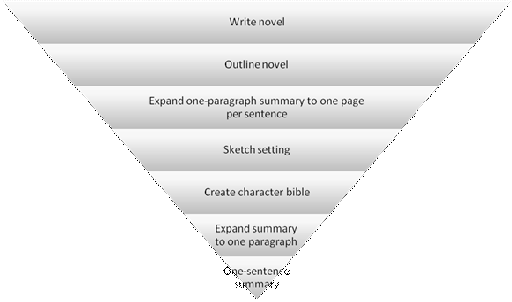
And it works. It works so well, that I finally understood why I couldn’t get past page 60 of the four mainstream lit novels sitting on my laptop, and I saw how I could give my mysteries the extra layer of of character complexity I’ve always felt they’ve lacked. Check out this graphic representation of my method, which I call the Pyramid on Point method, because it reminds me of a square on its side:
clip_image002

Here’s how it works. First, you write a one-sentence summary of your novel idea. This will come in handy when you’re marketing your manuscript or later, talking about it at conferences, but for now, the purpose is to coalesce your idea. Here’s the one-sentence summary for the November novel I’ll begin writing this winter: “A newly-minted Minnesota PI investigates a suspicious hunting accident, uncovering a brutal small-town secret.” Notice that specifics aren’t important—names, places. You’re just taking an aerial photo.

Next, expand that summary into a paragraph. This should take about an hour. Include the status quo state at the beginning of the novel, what obstacles the protagonist encounters, and how the novel ends. After you’ve got that summary, invite your characters. Get a notebook or open a document on your computer and create a page for every character who’ll appear in the book. Flesh out the basics, like age and appearance, but more importantly, spell out their goals and motivations, the conflicts they encounter and how they’ll grow from them, and their general storyline in this novel. The detail you add here is what will separate your novel from the pack by making it a character-driven story. Don’t be afraid to rewrite your one-sentence or one-paragraph summaries if your characters call on you to do so.

The next step is my favorite: physically sketch your setting(s). If your novel takes place mostly in a single town, draw a street and business layout. If it also spends a lot of time in a specific house or office, draw the floor plan. Also, keep on the lookout for photos online or in magazines that strike a chord with you. Print or cut them out and glue them into a notebook (where you may already have your character bible). When you get writer’s block later, looking at and writing about these photos will push you over the hump. Just don’t spend too much time at this step or you’ll go from writer to scrapbooker.

Next, expand each sentence on your one-paragraph summary to a full page. Include lots of sensory detail, especially smell, touch, and sound. These make your writing cinematic. After this, roughly outline your plot. I don’t believe in detailed outlines, which take the surprise and so the fun out of writing. Simply create a post-it note for each character conflict you’ve come up with (you’ll find these in step 3), with the character name at the top of each post-it, and rearrange these so they happen in a logical order. These conflicts are the nails on which you string your story.

Finally, write the dang novel. This is the thrilling part. You’ve done the difficult work of creating the structure, and it’s time to sit back and take dictation from the Muses. When you get stuck, recharge with your pyramid. Voila! I hope this method brings joy, structure, and depth to your writing like it did to mine. And please, add to my stone soup. What writing tips/method have worked well for you?

p.s. If you’re describing this method to your friends, don’t take the natural step of making an upside-down pyramid shape with your hands. I did this (frequently, and at waist level) during my presentation, and it turns out it means something entirely different in sign language, and it ain’t “pie.”