Just back from the 10th annual Crime Bake, a mystery conference for writers and readers held outside of Boston and sponsored by the NE chapters of Sisters in Crime & Mystery Writers of America. Thought I’d share a little report while the whole experience is fresh in my mind.
A panel with several “top guns” emphasized the need for persistence in our profession, as well as a little luck. Guest of Honor Nancy Pickard (The Scent of Rain and  Lightning) described herself as a “thirty year overnight success,” and said that although she came along in the early 80’s -- the right time for women in crime fiction (that’s the luck part) -- she realized early on that “somebody has to be published – it might as well be me.”
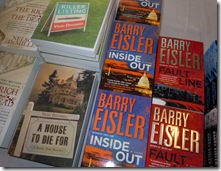 Barry Eisler (The Detachment), Nancy’s co-honoree, stressed hard work and our need as authors to stay on top of the entire process of publishing. He told many stories about less than stellar covers and/or titles of his books, decisions in which he was denied input and that led him to turn down a lucrative contract in favor of self-publishing. I hope he realized how lucky he was to have his books beside mine at the bookseller’s table…
 Michael Palmer (A Heartbeat Away, The Last Surgeon) consistently offered down-to-earth advice that really resonated with me, such as how important it is for writers to care about the characters they create. It made me think of an early version of my first mystery, A House to Die For. I had a smarmy spinal surgeon murdered in the prologue and my agent pointed out that he was a really despicable character. “Is anyone going to care that he died?” he wondered. In later revisions, I made Emerson Phipps more dimensional, making him a volunteer for a relief organization and showing him through the eyes of his sister as a loving uncle.
Frequently these conferences provide not only suggestions “from the experts,” but hard-earned wisdom from writers such as those of us blogging here. I spoke on a panel with three other series writers about setting and how it influences characters and plot. We had a nice crowd for our discussion and fielded many excellent questions from the floor. I came away with tips from the other writers as well as imparting some of my own.
Of course, we all know that writing conferences aren’t all work, work, work…
 I was thrilled to discover that Terri Bischoff, Midnight Ink’s Acquisitions Editor, was among the attendees, and she and I enjoyed catching up and talking mysteries. I met the owner of a bookstore in Vermont as well as several local readers who want me at their mystery club. I sold and signed copies of Killer Listing and made many new friends.
And then there is the ball…
This year the event featured “Sleuths, Spies, and Private Eyes,” and it was great fun. I dressed as Jill Masterson, the unfortunately gilded victim from Ian Fleming’s Goldfinger, and was delighted to discover 007 waiting when I exited the elevator. We teamed up as a last-minute entry in the “Partners in Crime” category of the costume contest and captured second place! (Mrs. Peacock and Mr. Boddy from CLUE beat us out.) Some of you know Nikki Bonnani who hosts the Killer Coffee Club… She came as a chilling Lizbeth Salander, dragon tattoo and all, and won the whole thing.
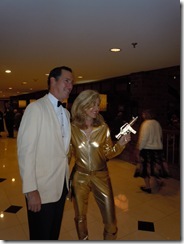 Dancing in gold lame may be akin to being sprayed with the precious metal, and by the end of the evening, I felt poor Jill’s pain. But I also felt buoyed up by the spirit of the conference: camaraderie, optimism, and sheer love of writing. I’m now back in Maine, hard at work on my manuscript, and using the tips I gleaned from Crime Bake to try and make it better.


