Friday, April 19, 2013
Our Guest Velda Brotherton's Take on Sympathetic Characters
Monday, October 8, 2012
Mary Sue Vs. Debbie Harry
I consider myself a tough broad. I have a mouth on me, dirty a lot of the times, I've walked through dangerous cities at night alone, I've seen someone assaulted and got my friends out of the situation while keeping a calm head, and I've kicked not one but three dudes in the balls when they wanted to play rough and I didn't. I can shoot a gun, change a tire, I kill spiders and open jars for my brothers, and I take shit from no one. I'm not ugly but it takes over an hour for me to become pretty. The only things I'm exceptional at are dispensing advice, story telling, and keeping fish alive (Beta Larry lived 2! years). I'm stubborn, solitary, I have no sex appeal or mojo, and I live with my parents. In other words, I am not a Mary Sue. I am a human being, flawed yet still fabulous. And so should your main character be.
I came across the term "Mary Sue" when I read an article on "Fifty Shades of Grey" (yes, I read the book. Got it from the library. Wasn't great, wasn't terrible, read it in about three hours.) Like most blockbuster books, there was some derision about it, especially from authors. So much was said but for the purpose of this blog I'll just focus on the main character Ana. She was definitely a Mary Sue: perfect, every male falling over her, had the supernatural gift of having mind blowing orgasms every time. The woman would not exist in the real world.
In this article (which I'm sorry I can't remember the name of, sorry) the author also mentioned that this type of character a "Mary Sue" was prevalent in Fan Fiction, which is how Fifty got its start. The term came into existence when Paula Smith wrote a short story about the type of female character prevalent in Star Trek FanFic. Mary Sue was only fifteen, a genius, the youngest lieutenant, with unprecedented skill in everything both mental and physical, and is beloved by all characters in this case especially Spock and Kirk. Mary Sue has no flaws, she struggles at nothing, and everyone fawns over her. In other words, she's boring. Unbelievable. Those are the worst words any writer can face.
If Mary Sue kept herself contained in the pages of FanFic I'd really have no problem with her. Full disclosure, I don't read or write FanFic. My roommate was obsessed with it, especially Wincest and Harry Potter/Draco Malfoy parings (EWWWW to both). I understand the desire to write them. These are characters you love, and in writing the Fic you get to tinker with those characters however you see fit. You put yourself into this fantasy world. You're in control. But before Fifty no one was really making money on it. Now publishers are trolling the sites for the next Fifty. Besides the copyright issues, my main concern is that more characters like Ana (a copy of Bella Swan) are going to be the norm. The only acceptable female lead will be demure, gorgeous, subservient, basically a feminist like me's worst nightmare. Ana let a man tie her up and spank her just to please him. Bella literally became a teenage bride, got knocked up, then DIED in childbirth. This is what has captured the minds of American women. It gives me chills.
And I was aghast to find how close I can to Mary Sueing in my own work. In researching the Mary Sue I did come to realize that I am a little guilty of making my main character Beatrice a Mary Sue, or bringing her right to the cusp. I've gone on record as saying I view Bea as an idealized version of me. I'm tough, but if a zombie horde was coming and it was people I barely knew or me, I'm pretty sure they'd be on their own. (At least I wouldn't hobble them like my bro Liam said he would. He is not going to be my zombie apocalypse buddy, that's for sure). Bea has more patience than me, men do fall over her (sort of), and she is very powerful. But she's also plain, makes very bad decisions that get people killed, and nothing ever comes easy for her. I worked in flaws. She doesn't get the guy right off the bat. Her team mates don't really like her. She saves people a lot more than they save her. In other words, she's not perfect and there's a reason for that. Perfection is boring. Who would you rather hang out with, spend money on? Little Miss Perfect Mary Sue or flawed, funny, tough Debbie Harry? Me, I'd rather spend an hour with an interesting shit than a whole day with a super nice person. You get more from Debbie than Mary Sue. When you're doing your writing remember that.
What about all of you? Do you prefer Mary Sue or Debbie Harry? Why? Am I being too hard on poor Mary Sue? Can you think of any other examples of either?
Tuesday, January 3, 2012
Defamation of Character
Thursday, November 10, 2011
With A Cast Of Thousands
by Kathleen Ernst
Well, no, not really thousands. But my current WIP, Beyond Death’s Door, does have a large cast. And although my protagonist Chloe is the primary character, three others have point-of-view scenes. Most of the book takes place in 1982, but it does include an historical timeline as well.
Given that, I’ve been thinking about including a “Cast of Characters” at the front of the book.
A recent discussion on a mystery writers’ Listserv touched on that idea. I didn’t catch it all, but at least some posters lamented how the inclusion of a cast list seems to have fallen from favor. I’m paraphrasing here, but one person noted that the characters weren’t the most important people in readers’ lives, as they may at times seem to the author. She voted in favor of inclusion.
Great! I thought. I will include a character list in Beyond Death’s Door.
Then I happened across a comment from Chris Roerden in her book Don’t Murder Your Mystery: 24 Fiction-Writing Techniques To Save Your Manuscript From Turning Up D.O.A. It’s a good book, and I often flip through it as I near the end of a draft. While encouraging writers to introduce characters gradually, she writes: “One novel I began to read named twenty characters in the first chapter. If I hadn’t been looking forward to reading that author, I would have viewed the family tree on the flyleaf as the omen it was.”
Obviously a too-big cast, poorly introduced, is not the hallmark of a great book. But her comment about the family tree on the flyleaf as “omen” gave me pause.
So…what do you think? Do you see a cast list as a helpful tool, or an omen of bad things to come?
Tuesday, July 19, 2011
WILL THE REAL (UNREAL) CHARACTER PLEASE STAND UP
One of the greatest joys of being a writer is to see a character you’ve created jump off the page and come to life. It’s something you can’t always plan, can rarely predict, and sometimes can’t explain even after it happens. It’s simply characters taking on a life of their own, turning in an award wining performance. And it often comes as a complete surprise to the author.
What a great feeling to have been the one to breathe life into them.

For a character appearing for the first time, then, the story becomes something of an audition. A screen test. A pilot episode that can either leave the character in relative obscurity or propel them into a very real life that will see them recur time and time again. Though not every character wins the Oscar, if an author is lucky, a handful of characters go on to story stardom.
To date, I’ve written and had published close to thirty short stories, my first novel in the Del Shannon series, Nazareth Child, is forthcoming in September, book two in the series is completed and has been turned in to the publisher, and my latest short story has been chosen for inclusion in the Lee Child anthology, Vengeance, slated for publication in April-May next year. All told, I estimate that I have created more than 150 primary and secondary characters (maybe another 100 walk-ons). Several of whom have become so real to me that I have taken them on more than one story journey.
They are all part of the fictional world that I inhabit as an author. And what great fun it is to see one of them continue down the path of life. Even more so, to see one stumble onto the landscape of another character’s story. It’s like running into an old friend at the bank (although, in this case, the old friend is probably there to rob it.)

Elmore Leonard does this superbly. I came to know Raylan Givens from the Leonard novels "Pronto" and "Riding The Rap". Later, I thrilled again to the character in the short story, "Fire In The Hole," appearing in the Leonard collection "When The Ladies Come Out To Dance." I’m now a devout follower of Raylan in the FX television original series, Justified, based on the character. I feel as if I have known Raylan (and, in some respects, Elmore) personally, for a very long time.
What about you? As an author, have you created characters that have demanded their own life and space in your fictional world? As readers, how does it feel to recognize a character from the past? What’s one of your most befriended recurring characters?
Monday, November 22, 2010
Holidays, Food, and Character Traits
I’m a pretty good cook, and I like working in the kitchen. I’ve been saying for
years that the first Thanksgiving after my maternal grandmother passed, her spirit touched my hands and gave me her gravy-making skills. Watching that smooth, rich, brown gravy come together exactly as planned was a beautiful moment.Some of my characters are good cooks. In my first (trunked awaiting rewrite) book, the horror plot was relieved by lots of good cooking. In my Falcone and Driscoll series, not as much, although I do manage to work in how to make homemade Sicilian pizza.
Other hobbies of mine, like knitting and playing musical instruments, aren’t as universal as cooking and eating. After all, Patricia Wentworth created the best detective-who-knits in Miss Silver. Is there a musician detective? I don’t recall one.
I’ve learned a few things as my characters have informed me of their talents and quirks. I know the techniques of cello playing, how to research someone’s ancestry, online RPGs, navel piercing, and all-natural foods.
Have you ever been so interested in a book’s MC that you wanted to learn to do what they do? In my own case, I got so irritated at Miss Silver’s continual “knitting in the Continental manner” that I taught myself that method. (I knit a lot faster now, and two-color knitting is a breeze.) Have you ever researched something for a book and ended up incorporating the skill into your real life?
I’ll be happy to share my recipes with anyone. And then we can head to the gym together. Wednesday, October 27, 2010
Halloween!
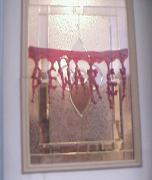
You may know some people who are Christmas Elves—the kind that eat, sleep, and breathe Christmas from November 1 through January 31. I’m not one of them. I’m the evil broad whose house has a homemade graveyard, hidden light-up eyeballs, ghosts dancing around my apple tree, and a shrieking doormat. Oh, and bloody words in the windows. And that’s just the outside.
So, even though The Day is still a few hours in the future, I’m starting the celebrations now. And I’d like to thank the chocolate companies for those lovely "$1.00 off 2 bags of candy" coupons that appeared in the Sunday paper all month. My waistline doesn’t thank them, but nothing’s perfect.
A trunked novel of mine has a huge Halloween party, but I don’t see one happening in a future book, yet. As a writer, I love the challenge of a crowd scene. How to keep the focus on your MC. How to bring in the right kind of characters for color and effect while making the party move the plot along. How to rein in the party-ness of the scene while making the reader hear the music, the conversation, the overall noise; smell the perfumes and the food, feel the breeze from the open windows and inhale the scent of late October: leaves, earth, that underlying chill that says the “s” word is right around the corner.
In the Northeast, “snow” is definitely a four-letter word. Especially by March. But that’s another post. Cabin fever, anyone?
Now, however, it’s my favorite holiday of the year. Bring on the monster movie marathons. The cheesier the better, although I do own some truly frightening movies for late at night.
I love fun “scares” but I also love edge-of-your-seat scares. The kind that make the reader turn on a few more lights while they finish a chapter. I once said that my writing goal was to create a character as enduring as Dracula or Sam Spade. What are the most memorable scares and characters you’ve read?
While I wait for your answers, I’ll just be outside putting a few more ghoul effects in my graveyard. There are cute little neighborhood kids to scare.
Tuesday, April 7, 2009
Alexander McCall Smith and the Case of the Helpful Reader
by G.M. MallietAlexander McCall Smith has written an article for the WSJ that's as engaging as any of his novels. In the article, he talks about how readers can get so caught up in an author's characters they start wanting to dictate "What happens next." I was amazed to learn that one of Smith's characters, Isabel Dalhousie, formed a relationship with a younger character in reaction to a complaint the author received from a journalist. It was this journalist's opinion that it was wrong to deny these characters a romantic attachment, despite the difference in their ages, so this attachment got written into the series.
I was saddened to hear that Mr Smith succumbed, but the pressure on such a popular author must be intense. Everybody "owns" Precious Ramotswe; everybody "owns" Isabel. It is part of Smith's great achievement that he made them seem so real, and endeared them to us. We care what happens to them, in the same way we care what happens to a friend.
I posted a link to the WSJ article on Facebook and someone commented that this was why they couldn't bring themselves to read The Remorseful Day, in which Inspector Morse dies. That is exactly it--Morse (and John Thaw) had become so real to us throughout the series we couldn't bear to say goodbye.
Both Colin Dexter and Alexander McCall Smith have more than earned the right to let their characters do as they choose--or rather, as their authors choose. And surely, that is any author's right. What else are we here for but to either keep our characters in line or let them run wild, only to be reined in later? Someone has to be in charge, and I think it has to be the author. (If anything, I would have preferred that Isabel remain single, but I wouldn't have dreamed of trying to bend the author to my will.)
Have you ever altered the direction of a series because of input from a fan? (And have you lived to regret it?)
Photo from www.telegraph.co.uk
Monday, March 31, 2008
The Unexpected Guest
In the middle of the night on a mist-shrouded country road, Michael Starkwedder runs his car into a ditch. When he goes to the nearest house for help, he finds a murdered man in a wheelchair and a woman holding a smoking gun.
That's the opening scene of Agatha Christie’s classic play, The Unexpected Guest, adapted as a novel by Charles Osbourne. No spoilers here, but suffice it to say that the action goes inside-out when Michael Starkwedder arrives.
Precisely what happens when unexpected guests appear on my pages. Even though I (attempt to) outline before drafting, characters I never saw coming invade my plays and novels. In response, I do the only thing I can: sit back and watch as they take over what I erroneously believed was my story.
Case in point: An Ann Arbor-based animal rights advocacy, Four Legs Good (a.k.a. Fleggers), blindsided me while I was drafting the second Whiskey Mattimoe mystery, Whiskey Straight Up. Founded by a veterinarian with a speech impediment and no sense of humor with humans, Fleggers has been shaping my plotlines ever since. Poor Whiskey still struggles with the term “anti-speciesist.” So do I.
Another case in point: A hunky Scot named MacArthur stunned me when he showed up in Chapter One of Whiskey and Water claiming to be a “cleaner.” His biz had nothing whatsoever to do with either yard work or maid service although he did pick up dog shit. You’d have to read the series to appreciate how much that pleased Whiskey. The cleaner revealed many talents, including a knack for erasing celebrity hijinks. And selling real estate. He's versatile enough to resurface in the book I’m writing now, Whiskey with a Twist. I wonder what he’ll do in this one.
Have unexpected guests changed the course of your fiction? If not, just wait. . . .
Wednesday, March 5, 2008
Character or Caricature?

The other night my guy and I went to a birthday party. A few minutes after we got there, a man I will call TJ walked up to us.
“Hey there.” Points to himself. “TJ. I’m here as R’s date. Not that we’re you know, dating. We’re just ----ing. Hahahahaha. I don’t know you. I’d remember if I knew you because I always remember good lookin’ women.” Peers around. “Where’s my friend Jack?”
And off he went to find his fifth of Jack Daniels, which he carried with him all evening, swigging directly from the bottle until it was gone. I kid you not. Why, after all, dirty a glass?
Then he passed out in the backyard.
Between his delightful greeting (we had, in fact, met before, and it was just as unpleasant the first time) and his blessed unconsciousness, he yammered loudly to anyone within listening range, insulted several of the other party goers, made out with some woman who was not his “date” for the evening, and had his face slapped.
Now: this was a large party with lots of people. Most of us were well over the age of forty, with a few thirty-somethings tossed in. There were martinis and mojitos, chatting and catching up, lots of laughter and a little dancing later on. It was, in short, a fun time.
Except, of course, for TJ. He was obnoxious, loud, and rude when sober, and then he and Jack managed to exacerbate those marvelous qualities as the evening progressed. And to make it worse, the woman who was supposed to be his date was the birthday girl.
At one point my S.O. breathed into my ear, “Oh, man. You have to put that guy in a book. He’s a perfect asshole.”
Ruefully, I told my dear one that however much I’d love to mine such an extreme character, he was, unfortunately, too perfect. TJ was simply too much that guy: a caricature of himself. A real person who could only be a cliché in fiction.
At a recent reading, a woman asked whether the people I base my characters on recognized themselves in my writing. Her question presupposed that I use friends and family as characters, and I had to explain that I really don’t do that.
She insisted that you have to write what you know, so my fiction must reflect actual people. I pointed out that I also know all the other folks I’ve met in a lifetime of reading fiction and non-fiction, as well as watching movies and television. So if you take that into consideration, the questioner was probably right.
Last week my aunt called. She said she’d read Lye in Wait, and she’d finally figured out who everyone in the book was.
I made inquisitive noises, though I suspected where the conversation was headed.
“Tootie is your great grandmother McCoy, isn’t she? But are you Sophie Mae or Meghan?”
Neither one. Both. In fact, I’m everyone in my books, to a degree, because I can’t help but write from aspects of myself. Sophie Mae isn’t me, though we share some of the same interests. And Meghan isn’t me, though I’m short and have brown hair. Barr Ambrose isn’t me, though I’m originally from Wyoming. And Erin isn’t me, even if I was a smart ass ten-year-old.
Maybe I can't put TJ into a book until I get better at being a jerk. I'll try and work on that.
So where do your characters come from? Are they alter egos? Have you ever put someone you know directly on the page? Do you get to know your characters as you write, or do they come to you fully formed?
Monday, March 3, 2008
Rules of Engagement
A funny thing happened on the way to writing this blog post. I got engaged . . . to be married. Here I was, all set to blog about “unexpected guest” characters—you know, those fictional folks you don’t see coming who nonetheless show up on the page and change everything—when my significant other slipped a ring on my finger. A very nice ring, I might add.
The Unexpected Guest Character post will have to wait because my new status as fiancée has filled my head with entirely different notions. And I’m not talking about wedding plans although The Event will certainly require some forethought. Not to mention the fact that we're contemplating a move to another part of the country. No, what I’m thinking about now is the way my attitudes toward love and lust manifest in what I write.
During the years when my previous marriage—a long one gradually destroyed by his preference for booze over employment—was in decline, the women in my fiction were either leaving their husbands or coping with the death of their husbands. That includes my first teen novel and my first Whiskey Mattimoe mystery. In the years following my divorce, I wrote about women falling into passionate love with thrilling but inappropriate men. Let's just say I enjoyed the research.
My ex insisted he never saw the divorce coming. Being drunk most of the time made it hard for him to keep up. He might have got a clue if he had read Whiskey on the Rocks or Homefree, or even considered the titles. My whimsical play Cherchez Dave Robicheaux offered a big tip: the heartsick protagonist leaves her husband for a fictional character. My protagonist was more desperate than I was.
Enough about what came before. What’s happening now is that I’m engaged to a tender, funny, generous man who puts family and friends first. Although more into sports than literature, he used to be a professional speechwriter; thus, he respects my work. I met my fiancé when I wasn't looking for love, yet I knew almost immediately from our ease with each other that he was Mr. Right. Never mind that he wasn't my “type,” and I'd never written about loving a man like him.
In the movie Definitely, Maybe the hero concludes that finding the right partner may be more a matter of when than whom. Put another way, you have to be ready. I opened my heart and recognized a fine man when I met him. The rest was easy. But if I'd met my guy a couple years earlier, I doubt we would have clicked. Timing, as they say, is everything. And I'll go a step further: anything I've ever tried to force has failed, be it a relationship, a storyline, or a laugh.
Fiction is the realm where I play with my fears and fantasies. But life is where I live them, and it offers more surprises than I can make up.

Your turn. Tell us a little about the relationships, romantic or otherwise, you've built on the page . . . if you dare!
P.S. Happy Birthday, Inkspot! This blog was conceived one year ago today. Jess Lourey gets credit for thinking of it, Joe Moore for building it, Keith Raffel for scheduling it, and the rest of us for contributing essays once a month.