Showing posts with label setting. Show all posts

Friday, October 21, 2016

Setting Versus Sense of Place

By Lisa Alber

The other day I posed a question on Facebook:

Hive mind question--I'm curious: What do you mean when you use the terms "setting" versus "landscape" versus "sense of place"? To what extent are they interchangeable?

I had been invited to be the author of the evening for a monthly series called "Wordscrafters and Wine on Wednesdays." As the guest, I was expected to talk in a teacherly fashion, which is to say impart craft wisdom, tips, tricks, how-tos to other writers.

I said "yes" to the event because a friend asked, because I support the nonprofit that hosts the event, and because I try to say "yes" to things. But ... I'm not a teacher, never have been, and I don't have natural teacher skillz -- and besides, what craft knowledge did I think I could impart anyhow? I'm the perpetual student of writing craft.

I decided to talk about an aspect of writing that I love, which is an aspect of the craft that also confounded me at the beginning of my writing journey: "sense of place."

What is that reeeealllly? Isn't it the same thing as saying "setting"? (And then there's the term "landscape" -- but I set that topic aside for my talk.)

As I learned when I posed the question on Facebook, people think of "setting" versus "sense of place" (versus "landscape") in slightly different ways, much of this being a question of semantics. Perhaps we writers think about these terms in ways that help us write the best stories we can. For me, this means that "setting" is not synonymous with "sense of place."

When I was starting out, I didn't understand what the fuss was about when it came to "sense of place." I was writing a novel set in western Ireland circa 2008, and -- duh -- the way to render this setting for readers is through specific detail that uses all five senses.

Ta-da -- "sense of place."

Yeah -- NOT. I was missing something in my understanding of the craft of sense of place, but, of course, being a beginner, I didn't know what I didn't know. This is where workshopping and feedback come in handy, where the revision process enhances our understanding of craft.

What I didn't realize was that beautiful, specific settings don't become "sense of place" until you infuse them with character. Without using your POV character as the filter through which you render the world, all you've got is description that's static. No emotional resonance. No soul. No heart.

You know when you hear readers say that they skip the descriptions? I would bet in most cases, those descriptions are static -- just the author describing the environment around the character rather than describing the environment through the character. I think of this as "pertinence." Is the description pertinent to the character at this moment in the story?

So, to me, "sense of place" is setting + characterization. Sense of place is the whole world the character inhabits, the outer world plus the POV character's interior landscape (there's that "L" word again--but I like using the word in this context), which includes her inner conflicts, agendas, goals, mood, aches, emotions, cultural context (say, for example, being a newcomer to the place versus a native), etcetera.

Imagine a kitchen window above a sink with sunlight coming through it, highlighting dew on a spider web. That's nice, but so what? Easy enough to be specific, but is this description also pertinent?

Adding character, let's pretend you have a grieving mother of a dead child: Perhaps the spider web dangles in tatters as the spider huddles off to the side, not even trying to repair it. The sunlight highlights the fragility of the spider's little world, so easily torn.

Or, a rebellious teenage daughter: Stuck like the frickin' spider, always the same web, and it maybe looks beautiful, all perfect and symmetrical and pleasing to the eye, but that spider is a prisoner--it just keeps doing the same thing day in and day out until it dies.

These are simplistic examples that touch on what I mean when I think of "sense of place." You may ask, What about so-called "literary" novels that are known for their long descriptive passages? I maintain that the ones that really work, the ones where you don't skip reading those passages, are infused with character. The character's voice and attitude coming through in how they perceive their world--and so those scenes still have forward momentum. Whereas, static description halts the story, or at least slows it way down, and sometimes reads like <gasp> authorial intrusion.

And if that pretty picture of the sun-glistening spider web isn't pertinent to the character in that moment? CUT IT. Find some other way to render the character's environment that provides emotional resonance. Sink full of moldy dishes to help show that character is terribly depressed? One chipped antique teacup to show the character's genteel but impoverished circumstances?

Specific and pertinent. (Also, remember the other four senses--not just visual.) I can't tell you how long it took me to get a grip on this. I was great with description/setting, but I sucked at sense of place.

There's so much you can do with sense of place. You can pan out to an omniscient POV to set a mood or tone (gothic novels are great at this) and then when you pan-in to the character POV you echo that mood or tone with the way the character filters her surroundings. Using sense of place is a great tool for foreshadowing, increasing suspense, and showing character in general.

Whew! So, come to find out that I did have a lot to say about this topic, and, in the end, the participants of the event (which was held in a winery--so, yes, wine!) engaged in a rousing discussion that went beyond my take on "sense of place."

Do you skip reading the descriptions? What do you mean when you use the terms "setting" versus "sense of place"?

Monday, May 9, 2016

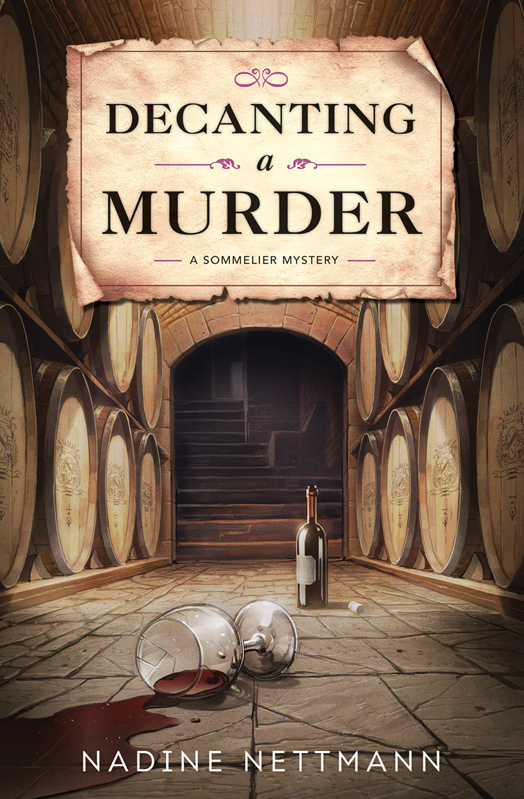
BOOK LAUNCH MONDAY | Nadine Nettmann on her Debut Novel Set in Wine Country


Web mistress Lisa here to introduce Nadine Nettmann, whose debut novel, DECANTING A MURDER, has just released. Today she shares her decision about choosing the location for her novel. Please welcome Nadine! ~Lisa

Setting a Novel in Napa

When it came time to choose a location for my debut novel, Decanting a Murder, I had a decision to make. Although I knew the novel would take place in a winery, I had to decide where the winery would be set. Which one of the many wine regions would be home to the start of my series?

After I became a Certified Sommelier through the Court of Master Sommeliers in 2011, I immediately wanted to visit wine regions around the world. There’s something to be said for seeing where the grapes are grown, the topography of the area, and the way the sun shines on the vineyard. You learn so much more about the wine, and I truly love knowing the story behind each and every bottle.

Although I was only outlining the story at this point, I wanted to have the location set before I put words on the page. Because, as you’ll find, the essence of the wine region flows throughout the story. I’ve traveled to wine regions around the world from Chile to South Africa to vineyards all over Europe, but after some consideration, I decided on California’s Napa Valley which has more than four hundred wineries.

There were a few reasons for choosing Napa, but the main tipping point was because I’m a native of California and I thought it would be fun to start the series close to home.

But why set it at a winery if my main character is a sommelier who works in a restaurant? I wanted to start the series where the wine’s journey begins, which is in the vineyard. It’s the start of each bottle’s story before it’s opened at a restaurant or at home.

Though the first book takes place in Napa, I would like to have each book set in a different wine region. For example, the next book, Uncorking a Lie, takes place at a dinner party in Sonoma, a wine region not too far from Napa.

I hope readers enjoy a glimpse of Napa Valley in Decanting a Murder. Every chapter is paired with a wine so get your drinking glasses ready!

Thanks for joining us, Nadine! Do we have any wine lovers in the house? Are you a red wine person or a white wine person? 

Nadine Nettmann, a Certified Sommelier through the Court of Master Sommeliers, is always on the lookout for great wines and the stories behind them. She has visited wine regions around the world, from Chile to South Africa to every region in France, but chose Napa as the setting for Decanting a Murder, her debut novel. Nadine is a member of Mystery Writers of America, Sisters in Crime, and International Thriller Writers. She lives in California with her husband. Find out more about Nadine at Nadinenettmann.com

Decanting a Murder is available at Amazon and Barnes & Noble 

Monday, November 2, 2009

The Where of a Story

Cricket McRae
One of the definitions of cozy mysteries is that they are set in small towns, or at the very least communities small enough to limit the number of characters. Think retirement homes or resorts.

My books, whether I like it or not, are classified as cozies. I insist on calling them contemporary cozies so I don't feel guilty about the occasional bad language or sexual reference. I also address issues like suicide, depression and alcoholism, which once caused a potential blurber to offer me his (polite) refusal rather than the hoped for pithy cover endorsement.

Now, I'm not interested in addressing the whole question of whether "cozy" is a negative appellation or how to define the subgenre. That's been covered ad infinitum on other blogs, DorothyL, etc., and I don't need to add to that particular fray. In fact, this is the last time you will read the word cozy in this post.

Thank God.

Because today I'm thinking about how setting affects story. And here's why: My books are set in the small town of Cadyville, Washington, which is based on the real town of Snohomish, Washington. But my protagonist is originally from the town I now live in which is located in northern Colorado. Well, a fictionalized version of that town. And in the fourth in the series, Something Borrowed, Something Bleu, I bring Sophie Mae back home for a visit.

I thought it would be easy. After all, I live here. How hard could it be?

Pretty darned hard, it turned out.

In the triumvirate of character, plot and setting, setting generally comes in last despite its importance. You can't have a story without a plot, or without characters to enact that plot. Can you have a [good] story without setting? I won't say absolutely no, but it would be quite rare.

Think about the movie Deliverance. Not for too long because I don't want you to get creeped out and move on to the next blog on your list. Could that movie be as effective if it were set in an English village? Or Miami? What about Lord of the Flies set in a sleepy mid western town?

Maybe. Dropping character and plot into an unlikely setting is a way to shake things up or make a point. Romeo and Juliet has been told in countless ways in different settings. And with different characters, for that matter. Hamlet as well. But The Tempest requires the original setting. Midsummer's Night Dream does, too.

I've always enjoyed weaving setting into a story. Description adds depth and atmosphere and evokes the senses, and I love finding just the right telling details. Perhaps writing a series allowed me to get lazy, though. Not in terms of describing setting, but in terms of having to define that setting over and over. The house, the weather, the town of Cadyville -- all are so thoroughly ingrained in my psyche by now that I no longer create details, I merely share them. Of course there are new and different settings in each book, but the basics have remained the same for the first three.

As a reader, consistency of setting is comforting. I'm instantly grounded. Plop me down in Nero Wolfe's brownstone, and I can find my way around. Take Jessica Fletcher out of Cabot Cove and start jetting her around the world, and the show jumps the shark. (Yes. I watched Murder She Wrote. It was about a mystery writer, and I'm not apologizing.)

So it was tricky, getting that sense of the familiar in an unfamiliar place to work in Something Borrowed, Something Bleu. I think I pulled it off, but time will tell. Or rather, my readers will, when it comes out next spring.

What role does setting play in your writing -- and reading?